U.S. College Costs 2026: Beyond Tuition Fees

The True Cost of a U.S. College Education in 2026: Beyond the Tuition Sticker Price
The dream of a U.S. college education remains a powerful aspiration for millions of students and their families worldwide. However, as 2026 approaches, the financial landscape of higher education continues to evolve, presenting both opportunities and significant challenges. For many, the term "college cost" immediately conjures images of exorbitant tuition fees. While tuition undeniably forms a substantial portion of the bill, understanding the US college costs in their entirety requires a deeper dive into a myriad of other expenses that often go overlooked. This comprehensive guide aims to demystify the financial realities of pursuing a degree in the United States in 2026, offering insights into projected costs, hidden fees, and strategic approaches to financial planning.
The rising cost of higher education is a persistent concern, and prospective students and their families must equip themselves with accurate information to make informed decisions. Merely looking at the published tuition rate is akin to reading only the first chapter of a complex novel – it tells an incomplete story. Our goal here is to provide a holistic view of what students can expect to pay, ensuring no stone is left unturned in the quest for financial clarity.
Understanding the "Sticker Price" vs. "Net Price": A Crucial Distinction in US College Costs
Before delving into specific figures, it’s vital to distinguish between two key terms: the "sticker price" and the "net price." The sticker price, also known as the Cost of Attendance (COA), is the total published cost of a college before any financial aid is applied. This includes tuition, fees, room and board, books, supplies, transportation, and personal expenses. The net price, on the other hand, is the actual amount a student pays after grants, scholarships, and other non-repayable aid are deducted. Understanding this difference is the first step in accurately assessing US college costs.
Many families are deterred by the sticker price, often believing that a particular institution is financially out of reach. However, a significant percentage of students receive some form of financial assistance, dramatically reducing their out-of-pocket expenses. Therefore, focusing solely on the sticker price can be misleading and may prevent students from applying to institutions that could, in fact, be affordable after aid.
Projected Tuition and Fees for 2026
Tuition and fees remain the most significant component of college costs. While exact figures for 2026 are still projections, historical trends offer valuable insights. Over the past decades, tuition has consistently outpaced inflation, though the rate of increase has shown some signs of slowing in recent years at certain institutions, partly due to public pressure and increased scrutiny. However, it’s prudent to anticipate continued modest increases.
- Public Four-Year Institutions (In-State): For the 2023-2024 academic year, the average tuition and fees for in-state students at public four-year universities hovered around $11,260. Projecting a conservative annual increase of 2-3%, this figure could reach approximately $11,900 – $12,200 by 2026.
- Public Four-Year Institutions (Out-of-State): Out-of-state tuition is significantly higher, averaging around $29,150 in 2023-2024. With similar growth, this could be in the range of $30,800 – $31,500 by 2026.
- Private Non-Profit Four-Year Institutions: These institutions typically have the highest sticker prices, averaging about $41,540 in 2023-2024. By 2026, this could potentially climb to $43,900 – $44,900.
- Two-Year Public Institutions (Community Colleges): Community colleges offer a more affordable entry point, with average tuition and fees around $3,860 in 2023-2024. This might see a slight increase to $4,080 – $4,180 by 2026.
It’s crucial to remember that these are national averages. Costs can vary dramatically based on the institution’s reputation, location, and specific programs of study. Elite universities, specialized programs (e.g., engineering, medicine), and institutions in high-cost-of-living areas will likely be at the higher end of these projections. These figures represent the baseline for understanding the tuition component of overall US college costs.
Beyond Tuition: Unpacking the Hidden Layers of US College Costs
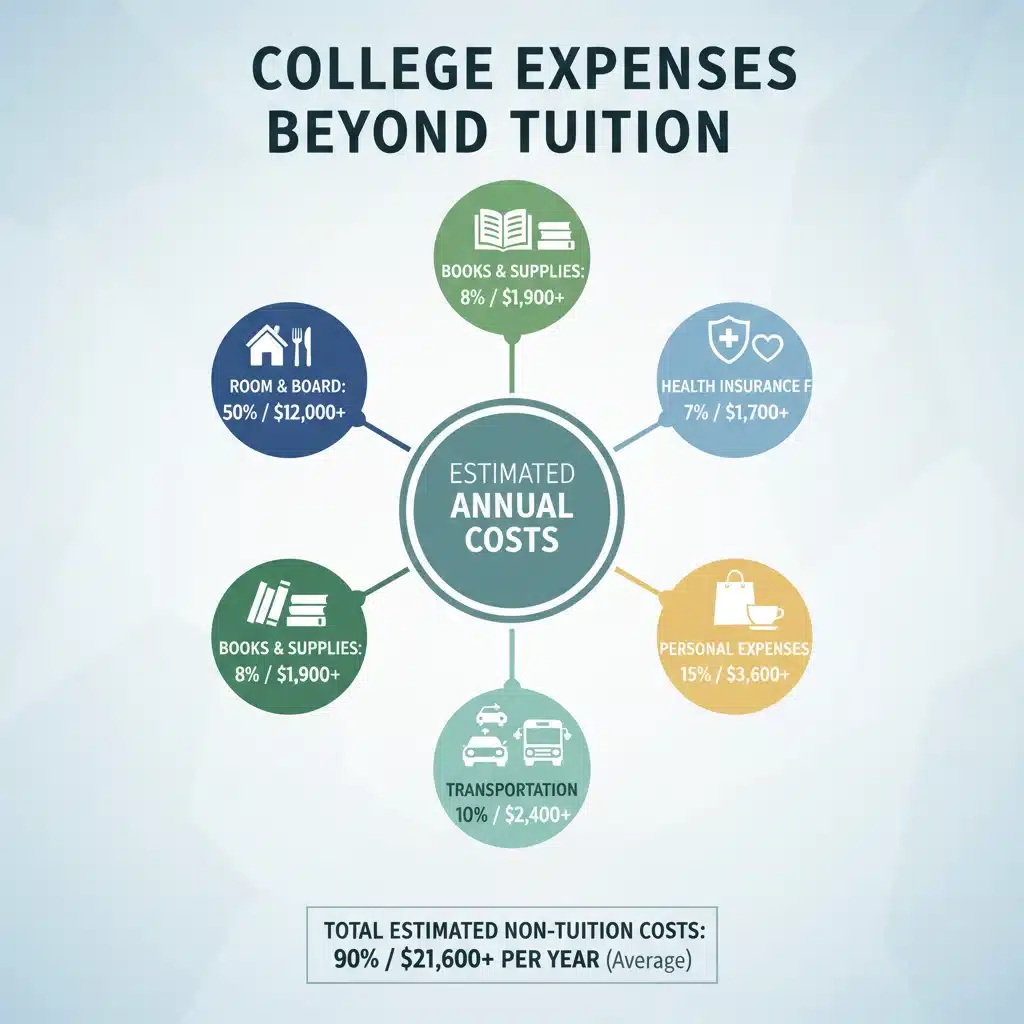
The tuition fee is just one piece of the financial puzzle. A comprehensive understanding of US college costs demands a thorough examination of other significant expenses. These "hidden" costs, while often predictable, can collectively add tens of thousands of dollars to the total bill over four years.
Room and Board: The Largest Non-Tuition Expense
For most students living away from home, room and board constitute the largest expense after tuition. This covers housing (dormitory or off-campus apartment) and a meal plan. The costs vary widely based on location, type of housing, and meal plan choices.
- On-Campus Housing: In 2023-2024, the average cost for on-campus room and board at a four-year institution was around $12,720. By 2026, this could range from $13,400 to $13,700 annually. This typically includes utilities, internet, and a standard meal plan.
- Off-Campus Housing: Living off-campus can sometimes be cheaper, especially if students share apartments and cook their own meals. However, it also introduces additional costs like security deposits, furniture, utilities (which might not be included), and groceries. Rental markets in college towns can be highly competitive and expensive. For example, a shared apartment in a major city could easily run $800-$1,500 per person per month, plus utilities and food, potentially exceeding on-campus costs.
Families should carefully evaluate the pros and cons of on-campus versus off-campus living, considering not only financial implications but also convenience, safety, and the overall student experience. The choice significantly impacts the total US college costs.
Books and Supplies: More Than Just Textbooks
The cost of textbooks, course materials, and supplies can be substantial. While digital resources and rental programs have helped somewhat, students still face significant expenses. In 2023-2024, the College Board estimated an average of $1,220 for books and supplies. By 2026, this could climb to $1,290 – $1,320.
Beyond traditional textbooks, students might need specialized equipment for certain majors (e.g., art supplies, lab coats, engineering software, specific calculators). These specialized items can add hundreds or even thousands of dollars to the annual bill. Proactive students can mitigate these costs by buying used books, renting, utilizing library resources, or exploring open educational resources (OER).
Transportation: Getting To and From Campus
Transportation costs are often underestimated but can add up quickly, especially for students attending college far from home. This category includes:
- Travel to/from home: Airfare, train tickets, or gasoline costs for driving, especially during breaks.
- Daily Commuting: Public transportation passes, gas, parking fees, and vehicle maintenance for students living off-campus or commuting from home.
For the 2023-2024 academic year, the average transportation cost was estimated at $1,270. By 2026, this could be around $1,340 – $1,370, subject to fluctuating gas prices and travel demands. Students should research campus transportation options, carpooling, and student discounts for public transit to minimize this component of US college costs.
Personal Expenses: The "Miscellaneous" Category
This broad category covers everything from toiletries, laundry, and entertainment to cell phone bills, streaming services, and occasional dining out. While these seem like small, day-to-day expenses, they can accumulate significantly over a year. The College Board estimated average personal expenses at $2,240 for 2023-2024. This could rise to $2,370 – $2,430 by 2026.
Managing personal expenses requires careful budgeting and self-discipline. Students often find themselves spending more than anticipated on social activities, impulse purchases, or convenience foods. Developing a realistic budget and tracking spending are essential skills for managing this aspect of US college costs effectively.
Health Insurance: A Non-Negotiable Expense
Most colleges require students to have health insurance. If a student is not covered under a parent’s plan or an independent plan, they will typically need to enroll in the university’s student health insurance plan. These plans can cost anywhere from $1,500 to $5,000 per year, depending on the institution and coverage. This is a critical, often mandatory, expense that must be factored into the overall US college costs.
Other Potential Fees and Costs
Beyond the major categories, colleges often have a host of smaller, but cumulatively significant, fees:
- Activity Fees: For student organizations, campus events, and athletic facilities.
- Technology Fees: For access to computer labs, campus Wi-Fi, and software licenses.
- Lab Fees: For science courses requiring specialized equipment or materials.
- Matriculation/Orientation Fees: One-time fees for new students.
- Graduation Fees: Fees associated with receiving a diploma and participating in commencement ceremonies.
- Course-Specific Fees: For certain classes, especially those involving field trips, special projects, or unique resources.
- Parking Permits: If a student brings a car to campus.
These fees can vary widely from institution to institution and can add several hundred to over a thousand dollars annually to the total US college costs. Always review the detailed fee schedule provided by each university.
The Grand Total: Estimating the Full Cost of Attendance in 2026
Combining all these components, here’s a rough projection for the average total Cost of Attendance (sticker price) for one year of college in 2026:
- Public Four-Year (In-State): Approximately $11,900 (Tuition & Fees) + $13,400 (Room & Board) + $1,290 (Books) + $1,340 (Transportation) + $2,370 (Personal) + $2,500 (Health Insurance estimate) = ~$32,800 annually.
- Public Four-Year (Out-of-State): Approximately $30,800 (Tuition & Fees) + $13,400 (Room & Board) + $1,290 (Books) + $1,340 (Transportation) + $2,370 (Personal) + $2,500 (Health Insurance estimate) = ~$51,700 annually.
- Private Non-Profit Four-Year: Approximately $43,900 (Tuition & Fees) + $13,400 (Room & Board) + $1,290 (Books) + $1,340 (Transportation) + $2,370 (Personal) + $2,500 (Health Insurance estimate) = ~$64,800 annually.
These figures represent a significant financial commitment. Over four years, these totals can easily range from $130,000 to over $250,000 for a single degree. This underscores the importance of thorough financial planning and exploring all avenues for reducing these substantial US college costs.
Strategies for Mitigating US College Costs in 2026
While the figures can seem daunting, there are numerous strategies students and families can employ to reduce their out-of-pocket expenses and make college more affordable. Proactive planning is key.
1. Maximize Free Money: Grants and Scholarships
The most desirable form of financial aid is "free money" – grants and scholarships that do not need to be repaid. These can significantly lower the net price of college.
- Federal Grants: Programs like the Pell Grant are need-based and can provide substantial assistance. Eligibility is determined by the Free Application for Federal Student Aid (FAFSA).
- State Grants: Many states offer grant programs for residents attending in-state colleges.
- Institutional Grants/Scholarships: Colleges themselves are a major source of aid, offering both need-based grants and merit-based scholarships (for academic achievement, athletic talent, artistic ability, etc.). Some institutions meet 100% of demonstrated financial need.
- Private Scholarships: Thousands of scholarships are available from private organizations, foundations, corporations, and community groups. These require dedicated research and application effort but can yield significant rewards. Students should start searching early and broadly.
To access most forms of financial aid, completing the FAFSA is non-negotiable. It’s the gateway to federal, state, and often institutional aid. Be sure to submit it as early as possible after it opens (October 1st for the following academic year) to maximize your chances of receiving aid. The FAFSA determines your Expected Family Contribution (EFC), which colleges use to calculate your financial need.

2. Consider Affordable College Options
Not all colleges are created equal in terms of cost. Exploring more affordable pathways can drastically reduce overall US college costs.
- Community Colleges: Starting at a two-year community college and then transferring to a four-year institution can save tens of thousands of dollars, especially for the first two years of general education requirements. Many community colleges have articulation agreements with four-year universities, ensuring credits transfer smoothly.
- In-State Public Universities: For residents, in-state public universities offer a significantly lower tuition rate compared to out-of-state or private options.
- Colleges with Generous Aid: Research institutions known for their strong financial aid programs. Some highly selective private universities, despite high sticker prices, can be more affordable than public universities for students with significant financial need, as they often offer robust need-based aid packages.
- Online Programs: While not for everyone, fully online degree programs can sometimes offer lower tuition rates and eliminate room and board costs, though they may have other fees.
3. Reduce Time to Degree
Every additional year in college adds another year of tuition, fees, and living expenses. Strategies to graduate in less than four years (or on time) include:
- Advanced Placement (AP) / International Baccalaureate (IB) Credits: Earning college credits in high school through AP or IB exams can allow students to skip introductory courses and potentially graduate early.
- Dual Enrollment: Taking college courses while still in high school for both high school and college credit.
- Summer Courses: Taking a few courses during the summer can lighten the load during regular semesters or help accelerate graduation.
- Efficient Course Planning: Working closely with an academic advisor to ensure all courses count towards the degree and avoid unnecessary coursework.
4. Smart Borrowing: Understanding Student Loans
While grants and scholarships are ideal, many students will still need to borrow money. Understanding different loan types is crucial.
- Federal Student Loans: These are generally the best option due to fixed interest rates, income-driven repayment plans, and potential for deferment or forbearance. Subsidized loans (where the government pays interest while you’re in school) are particularly advantageous.
- Private Student Loans: Offered by banks and private lenders, these often have variable interest rates, fewer borrower protections, and typically require a co-signer. They should be considered only after exhausting all federal options.
Borrow only what you need, and thoroughly understand the repayment terms. Excessive borrowing can lead to significant financial strain after graduation, impacting future financial goals and increasing overall US college costs over the long term.
5. Work-Study Programs and Part-Time Jobs
Federal Work-Study programs allow students to earn money to help pay for educational expenses through part-time jobs, often on campus. These jobs are usually flexible and accommodate academic schedules. Even a part-time job outside of work-study can provide valuable income and help cover personal expenses, reducing the need for loans.
6. Tax Credits and Deductions
Families may be eligible for various education-related tax credits and deductions, such as the American Opportunity Tax Credit or the Lifetime Learning Credit. These can help reduce the overall tax burden and indirectly lower the net cost of college. Consult a tax professional for eligibility and specific details.
The Long-Term Investment: ROI of a College Degree
While the discussion of US college costs can be daunting, it’s important to view higher education as a significant investment in one’s future. Numerous studies consistently demonstrate that individuals with a bachelor’s degree earn significantly more over their lifetime than those with only a high school diploma. They also tend to experience lower unemployment rates and have access to a wider range of career opportunities.
The return on investment (ROI) varies greatly by major, institution, and individual career path. Researching average starting salaries for different fields, considering career growth potential, and understanding the job market outlook for specific degrees can help students make more informed choices about their academic pursuits in relation to the initial investment in US college costs.
Preparing for 2026 and Beyond: Actionable Steps
For students and families planning for college in 2026, here are concrete steps to take:
- Start Early: Begin saving and researching college costs and financial aid options as soon as possible.
- Estimate Your EFC: Use the FAFSA4caster or similar tools to get an early estimate of your Expected Family Contribution.
- Research Net Price Calculators: Every college’s website has a net price calculator. Use these tools to get a personalized estimate of what you might actually pay after aid.
- Apply for Scholarships Broadly: Don’t just rely on institutional aid. Seek out private scholarships from local and national organizations.
- Understand Loan Options: If borrowing is necessary, prioritize federal loans over private loans.
- Budget Meticulously: Once in college, create and stick to a detailed budget to manage personal and discretionary expenses.
- Consider All College Types: Don’t discount community colleges or in-state public universities as viable and often more affordable pathways.
- Engage with Financial Aid Offices: Don’t hesitate to contact the financial aid office at prospective colleges with questions or to discuss your specific financial situation. They are a valuable resource.
Conclusion
Navigating the complex landscape of US college costs in 2026 requires diligence, foresight, and a comprehensive understanding that extends far beyond the tuition sticker price. By factoring in room and board, books, transportation, personal expenses, health insurance, and various fees, families can develop a much more accurate picture of the true financial commitment. Fortunately, a wealth of financial aid options, strategic planning, and wise choices regarding institutional selection can significantly alleviate the burden. While the investment is substantial, a college education remains a powerful catalyst for personal growth and career advancement. With careful planning and a proactive approach, the dream of a U.S. college degree can remain an attainable reality for many.